

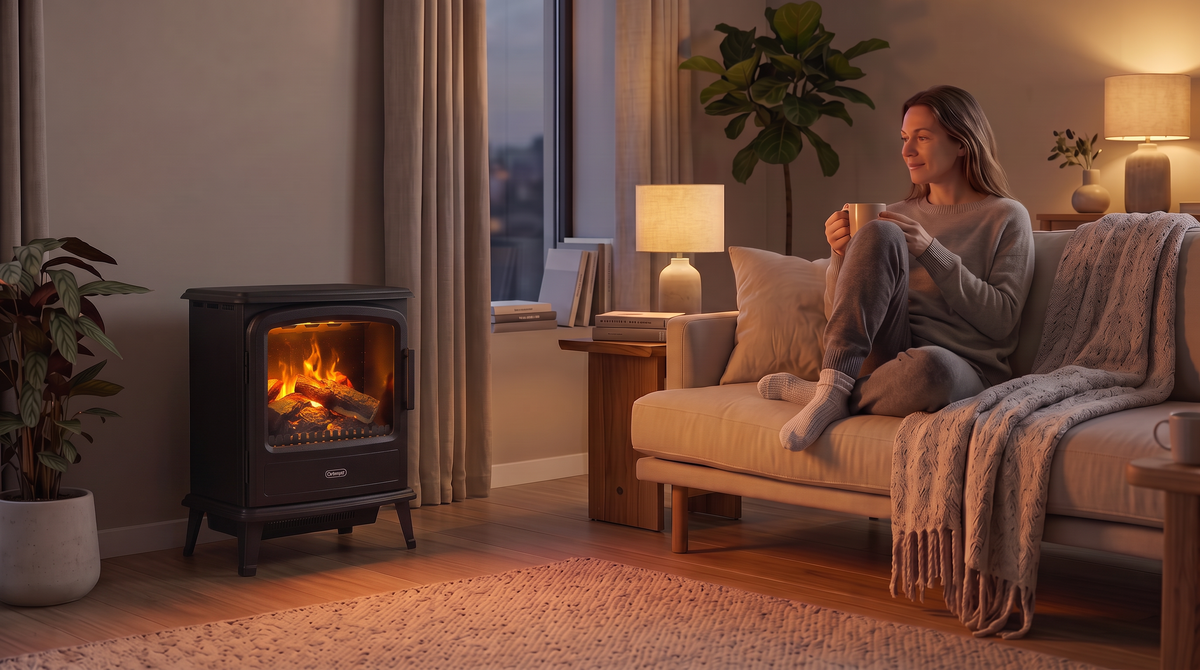
When it comes to gas vs electric fireplace stoves, gas usually wins on the cost of each unit of heat, while electric wins on installation, upkeep, safety and flexibility. If you mainly want a cosy focal point that heats one room for a few hours in the evening, an electric stove is often the simpler, cheaper-to-own choice. If you want to heat a large, draughty room for many hours a day, a gas stove can still make financial sense.
Gas vs electric at a glance
| Gas stove | Electric stove | |
|---|---|---|
| Installation | Gas Safe engineer, gas supply and suitable flue or chimney | Plug into a standard UK socket |
| Annual upkeep | Yearly service recommended | Dusting; water top-ups on Optimyst models |
| Price per kWh (Oct to Dec 2026 cap) | 7.97p | 26.32p |
| Efficiency in the room | Typically 70 to 85% for glass-fronted stoves, often far lower for open fires | Effectively 100% of the electricity becomes heat in the room |
| Flame without heat | No | Yes, flame-only setting |
| Combustion gases | Yes, needs a working flue | None |
Running costs: the honest maths
The Ofgem price cap for 1 October to 31 December 2026 sets average rates at 26.32p per kWh for electricity and 7.97p per kWh for gas, on direct debit. Gas is clearly cheaper per unit, but not all of it ends up as heat in your room.
Take a typical glass-fronted gas stove burning around 5kW of gas: that's roughly 5kW × 1 hour × 7.97p = 39.9p an hour. At around 80% efficiency, you get about 4kW of useful heat, which works out at roughly 10p per useful kWh. An electric stove on full power costs 2kW × 1 hour × 26.32p = 52.6p an hour for 2kW of heat, so 26.32p per useful kWh.
So per unit of heat, gas comes out cheaper. But the totals depend on how you use it. Most electric stoves, including the Emberly Optiflame Electric Stove, have a 1000W setting and a thermostat, so in a snug or a well-insulated room you might only pay around 26.3p an hour. And on mild evenings, the flame-only setting gives you the glow for a fraction of that. The cap changes every quarter, so it's worth rerunning these numbers.
Installation and upkeep
A gas stove needs a gas supply, a suitable flue or lined chimney and fitting by a Gas Safe registered engineer. Most manufacturers and engineers recommend a service every year, which typically costs somewhere around £70 to £100. Over ten years, that's roughly £700 to £1,000 in servicing alone, before you've paid for a single unit of gas.
An electric stove is a different proposition. The Jazz Noir Optiflame Electric Stove, for instance, is freestanding, plugs into a standard UK 3-pin socket and comes with a 1.8m cable. No flue, no sweep, no service visits. You can even move it to another room, or take it with you when you move house.
Safety and air quality
Any gas appliance burns fuel, so it needs a working flue and a carbon monoxide alarm in the room, plus regular checks. An electric stove has no combustion at all, which means no fumes and no flue to maintain. That said, it's still a heater: keep it clear of curtains and furniture as set out in the manufacturer's instructions, and never cover the heat outlet. If you keep other gas appliances, such as a boiler or hob, keep your CO alarms in place.
The Dimplex stoves mentioned here carry BEAB, CE and UKCA certification and come with a 2-year guarantee.
Does electric look as good as real gas flames?
Gas gives you real flames, and some people simply won't settle for anything else. But modern electric flame effects are far more convincing than the old glowing-bulb fires. Dimplex Optimyst stoves such as the Dimplex Grand Rouge Optimyst Electric Stove use water vapour lit by LEDs for a smoke-free, three-dimensional flame. The Oakridge uses Optiflame with flames visible from three sides and three flame speeds, plus app, remote or manual control.
Making the switch from gas
- Have a Gas Safe registered engineer disconnect and cap the old gas fire's supply. Never do this yourself.
- Decide what to do with the chimney: a ventilated cap or chimney balloon stops draughts.
- Check there's a socket within reach of the stove's 1.8m cable, or have an electrician fit one.
- Position your electric stove, add a hearth pad if needed, and enjoy.
So, which should you choose?
If you need hours of heat every day in a big room and already have a sound flue, gas still has a cost edge. For everyone else, an electric stove avoids installation, servicing and flue worries, and lets you enjoy the flames all year. See the full range of Dimplex electric stoves at shopdimplex.com, with free UK mainland delivery.

Leave a comment
This site is protected by hCaptcha and the hCaptcha Privacy Policy and Terms of Service apply.