

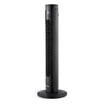
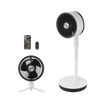

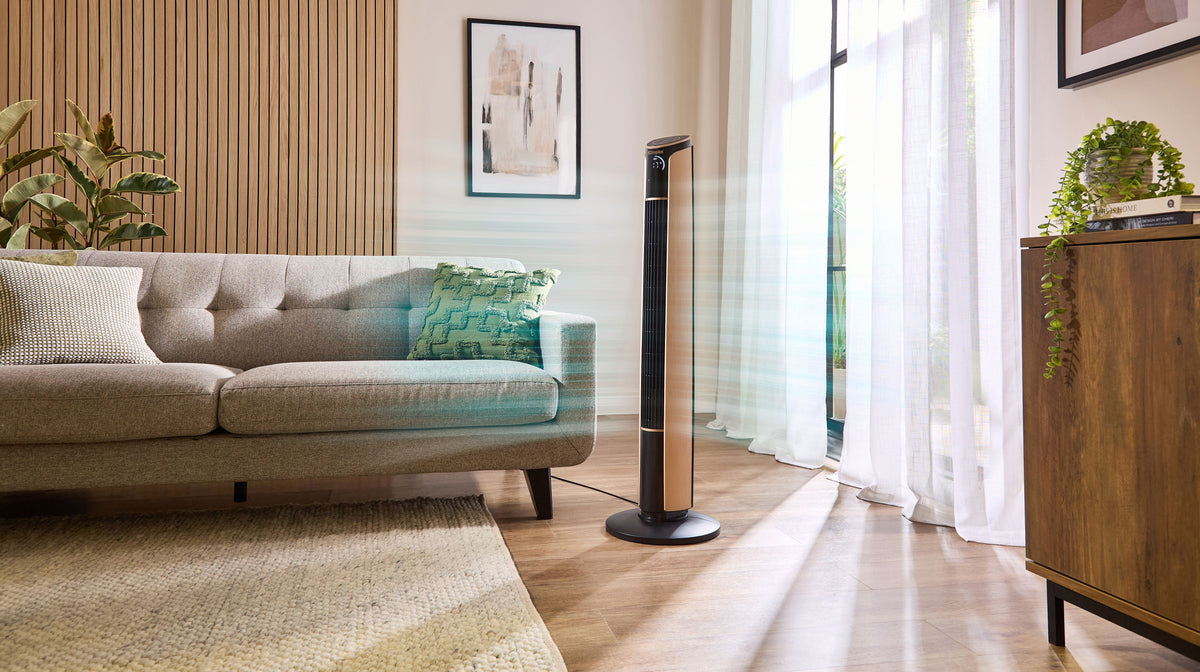
Bladeless fans have become one of the most recognisable appliances of the last decade. They look elegant, they're easy to clean, and they appear to produce airflow from thin air. But how do they actually work? There are no visible blades — so where does the air come from?
There are blades. They're just hidden.
Despite the name, bladeless fans do contain blades — they're simply hidden inside the base of the unit. The base houses a small but powerful brushless motor that draws air in through a series of intake holes around the lower section. That air is then accelerated by an impeller, a small fan with multiple blades, spinning at high speed inside the base. The key difference is that these inner blades never come into direct contact with your fingers or pets, making the fan significantly safer.
Air Multiplier technology: the clever part
Once air is drawn into the base, it's pushed upward into the hollow ring or loop at the top of the fan. This ring has a narrow aperture — essentially a very thin slot running around the inner edge. Air is forced through this slot at high speed and projected forward in a smooth, consistent stream.
But here's where physics gets interesting: as the jet of air passes through the aperture, it pulls additional air in from behind and around the ring through a process called inducement and entrainment. This dramatically multiplies the volume of air being moved — often by a factor of 15 to 20 times the amount originally drawn in through the base.
The result is a smooth, uninterrupted column of air rather than the choppy, buffeting airflow you get from a traditional bladed fan.
Why is bladeless airflow smoother?
Traditional fans chop the air as the blades rotate, which is why the airflow feels inconsistent if you wave your hand in front of one. Bladeless fans produce what's known as laminar flow — air moving in consistent, parallel layers without turbulence. This is why the airflow from a bladeless fan feels gentler and more natural, even when it's moving a large volume of air.
Are bladeless fans more energy-efficient?
Not necessarily more efficient than a well-designed conventional fan, but bladeless fans offer greater control. Because airflow is generated electronically rather than mechanically, the speed can be adjusted very precisely, which means you can find the lowest comfortable setting and stay there. Many bladeless fans also include sleep modes that gradually reduce speed through the night.
Why choose a bladeless fan?
Safety: No exposed blades means they're safe around children and pets.
Easy to clean: No blades to dust individually — a wipe of the outer surface is usually enough.
Quiet: The motor is enclosed and well-insulated in most quality models.
Aesthetics: A bladeless fan is a design statement as much as a functional appliance.
Shop bladeless fans at Dimplex
Explore our range of bladeless fans at shopdimplex.com. Engineered for smooth, quiet performance and designed to complement any modern home.
Browse bladeless fans at shopdimplex.com

Leave a comment
This site is protected by hCaptcha and the hCaptcha Privacy Policy and Terms of Service apply.